Author Archives: storyadmin

The War on Stupid People

In The Atlantic

AtlStupid

American society increasingly mistakes intelligence for human worth

From my article in the July/August 2016 issue of The Atlantic

As recently as the 1950s, possessing only middling intelligence was not likely to severely limit your life’s trajectory. IQ wasn’t a big factor in whom you married, where you lived, or what others thought of you. The qualifications for a good job, whether on an assembly line or behind a desk, mostly revolved around integrity, work ethic, and a knack for getting along—bosses didn’t routinely expect college degrees, much less ask to see SAT scores. As one account of the era put it, hiring decisions were “based on a candidate having a critical skill or two and on soft factors such as eagerness, appearance, family background, and physical characteristics.”

The 2010s, in contrast, are a terrible time to not be brainy. Those who consider themselves bright openly mock others for being less so. Even in this age of rampant concern over microaggressions and victimization, we maintain open season on the nonsmart. People who’d swerve off a cliff rather than use a pejorative for race, religion, physical appearance, or disability are all too happy to drop the s‑bomb: Indeed, degrading others for being “stupid” has become nearly automatic in all forms of disagreement. Read more

Tagged

Basic Income: A Sellout of the American Dream?

TrBasicIncome

Schemes for giving everyone a guaranteed income are gaining momentum in Silicon Valley and throughout Western Europe. It’s a great idea, until you look closely.

From my article in the June 2016 issue of MIT Technology Review

Matt Krisiloff is in a small, glass-walled conference room off the lobby of Y Combinator’s office in San Francisco’s South of Market neighborhood, shouting distance from some of the country’s wealthiest startups, many of which Y Combinator has nurtured and helped fund. Krisiloff, who manages the operations of the tech incubator’s program for very early-stage companies, is explaining why it is committed to investing an amount said to be in the tens of millions of dollars in a venture that is guaranteed never to make a penny.

It’s the simplest business model conceivable: hand thousands of dollars over to individuals in return for nothing, no strings attached. Krisiloff insists he and his Y Combinator colleagues can’t wait to get started giving away the money. “This could be really transformative,” he says. “It may help change how humans, society, and technology all operate together in the future.”

Proponents say a “basic income” is a way to liberate those who have struggled to find acceptable work: currently 7.4 million people are unemployed in the United States, another six million want full-time work but can only find part-time jobs, millions more have given up looking, and perhaps tens of millions have settled for jobs with low wages, skimpy benefits, or poor working conditions. But it can also be argued that the idea is a way of buying these people off, making it easier to avoid developing the education and training programs that would actually help alleviate income inequality and reverse wage stagnation. Could it just be a way to give up on providing the wide access to decent jobs that has long been considered an essential element of a healthy society? Or, to put it more bluntly: at a time when the tech economy is generating huge amounts of wealth, is Silicon Valley just attempting to appease those left behind? Read more

Improving Public Perception of Behavior Analysis

In a journal article, I explore why the field that does the best job at helping people change problematic behaviors is slighted by the media

From my article in the May 2016 issue of The Behavior Analyst

The potential impact of behavior analysis is limited by the public’s dim awareness of the field. The mass media rarely cover behavior analysis, other than to echo inaccurate negative stereotypes about control and punishment. The media instead play up AbaJournalCoverGenericappealing but less-evidence-based approaches to problems, a key example being the touting of dubious diets over behavioral approaches to losing excess weight. These sorts of claims distort or skirt scientific evidence, undercutting the fidelity of behavior analysis to scientific rigor. Strategies for better connecting behavior analysis with the public might include reframing the field’s techniques and principles in friendlier, more resonant form; pushing direct outcome comparisons between behavior analysis and its rivals in simple terms; and playing up the “warm and fuzzy” side of behavior analysis. Read more (paywalled)

Inside NASA’s New $18-Billion Deep-Space Rocket

Is NASA’s Space Launch System a flying piece of congressional pork or our best shot at getting humans to deep space?

From my article in the June 2015 issue of Scientific American

Deep inside a giant but little-known NASA facility, crews have for years been staging elaborately faked space missions. This is not a conspiracy theory. It is the sad tale of NASA’s Michoud Assembly Facility, the sprawling New Orleans complex where the space agency had for decades built its biggest rockets.

NasaSciamPicAfter the Space Shuttle’s last flight in 2011, Michoud’s massive hangar-like facilities were rented out to Hollywood studios, housing some of the production for Ender’s Game and other sci-fi movies. But lately a growing cadre of NASA engineers and other workers have been engaged on an important new production here—a sequel to NASA’s greatest days of human spaceflight. Michoud is back in the rocket-making business, serving as a factory for the biggest, most ambitious space vehicle ever to undergo construction: The Space Launch System, often called by its acronym, SLS.

The SLS is the rocket in which NASA hopes to thunder a crew of astronauts skyward from Cape Canaveral for roughly a year’s journey to the surface of Mars, while hauling the living quarters, vehicles and supplies they’ll need to spend at least a few weeks shuffling through the rusty dust there. That mission is still about 25 years away. But between now and then, SLS could carry people to the moon and an asteroid, and send a probe to search for life on one of Jupiter’s moons. It is an interplanetarily groundbreaking project, one of the most audacious NASA has ever undertaken.

Why, then, do so many people seem to hate it?  Read more (paywalled)

How Do You Sell a Product When You Can’t Really Say What It Does?

San Francisco startup Ploom has a high-tech spin on smoking tobacco (and certain other plants). It also has a huge marketing challenge.

From my article in the May, 2014, issue of Inc. Magazine

There are two big factors that favor Ploom’s James Monsees and his co-founder Adam Bowen in their quest to make tobacco cool again. One is that their devices let users pull from tobacco most of the nicotine and flavor of cigarettes in the form of vapor, without taking in the cigarette smoke–thus removing many of the health risks, according to some experts. And, as a major bonus, one of their devices has become the darling of the pot-smoking wojames-monsees-ploomrld, which is steadily converting to vapor even as that world swells with growing legitimacy.

But two big factors are also working against Ploom. One is predictable: fierce competition that’s likely to stiffen as both startups and tobacco giants invade the “e-cigarette” market–already worth nearly $2 billion a year and growing fast. The other is a bit less typical in the business world: Ploom can’t market on its strengths. That’s because making health claims and wooing drug users cause all sorts of problems for a company that’s trying to remain squeaky clean in the face of widespread disdain for, and the threat of regulation of, anything linked to tobacco.

That leaves Ploom with a burning problem: How do you expand a company when you can’t really talk about what your products are good for? Read more

America Is Burning: The Fight Against Wildfires

Wildfire2

Years of climate change, drought, and reckless development have transformed nearly all of the American West into a giant tinderbox. Is there anything we can do to keep from going up in flames?

From my article in the Aug, 2014, issue of Men’s Journal

Traffic jams are a fact of life in Southern California. But few motorists have seen the likes of the one that stranded thousands of vehicles in May on Interstate 5 near San Marcos, about 35 miles north of San Diego. As vehicles idled, walls of flame arcing as high as 50 feet, and whipped by winds of up to 70 miles per hour, raced along an adjacent hillside, ripping through acres of parched trees and shrubs and blotting out the sky with roiling, glowing, thick smoke. And that wasn’t the only out-of-control blaze raging: At one point, San Diego County firefighters were grappling with nine separate wildfires – and six of those blazes were winning.

….Big, out-of-season fires are starting to look like the new normal. For as long back as there are records, California’s wildfire season hasn’t truly gotten under way until fall. But through most of 2013 and 2014, wildfires have been raging almost constantly, essentially leaving the state with a 12-month wildfire season.

And it’s not just California. In May, Arizona, Oklahoma, and even Alaska all were hit by large wildfires, months ahead of schedule. More blazes are occurring in fall and winter, as well. “In November, a fire in the Colorado Rockies burned across a snow-covered forest while firefighters watched, astounded,” says Char Miller, a professor of environmental analysis at Pomona College, in Claremont, California, who studies wildfire. “That may be something no one has ever seen before.” Read more

The startups saving health care

3-mhealth_33254Obamacare is fueling a hot new industry that uses mobile technology to curb health care spending. Smart startups are already cashing in.

From my article in Inc. Magazine 

Three years ago, Sterling Lanier, a serial entrepreneur then running a successful market research firm, got a phone call from a medical researcher he knew at the University of California, San Francisco. The researcher wanted him to help with a pro bono project that involved gathering data on thousands of breast-cancer patients. The trick would be to find a good way to get patients to fill out tedious forms.

Nice guy that he is, Lanier agreed. The result, designed with a tech whiz named Boris Glants, was an iPad app that the two named Tonic. Tonic made it easy–almost fun–for patients to provide information about themselves and their health. Mission accomplished.

And that might have been that, except a few months later, Lanier got another call, this one from Georgetown University Medical Center in Washington, D.C. It turned out the UCSF researcher had shown off Tonic at a health care conference and stirred up some interest. It wasn’t long before Lanier…read more.

Can processed food be healthy?

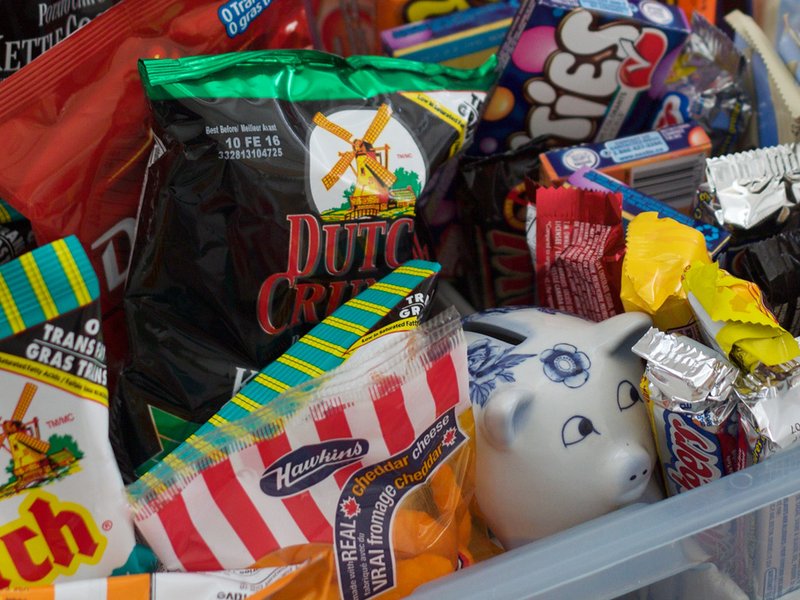
APMACNCHEESE1000-500x333Burger King makes a low-cal French fry. Processed food wants to compete on the health front. Can it?  Fake meat. Super soy. We’ll look.

From my September 2013 interview with NPR’s On Point 

We all know the mantra of healthy eating these days.  Lots of vegetables and fruit on the plate.  Not much meat.  Organic if you can.  And local is lovely.  We like to picture that armful of dinner ingredients fresh from the farmers market.

But what about all the people who don’t get close to that.  And maybe can’t afford it.  There’s a new buzz around processed food that’s being made and pitched as healthy.  Burger King’s low-cal fries.  Fake meat.  Seaweed chips.  Factory-engineered health goop.

This hour, On Point:  could processed food be re-engineered to save our health?  Or is that dreaming?…listen here (beginning at 15:20).

Foodie Heretic: Tackling the obesity health epidemic with -wait for it- fast food

From my interview with The Monthly TheMonthly-sub-too-much

For sure, an overreliance on fast food can lead to the fat farm, but what if it were less salty, fatty, sugary, and came in smaller portions? Science journalist David H. Freedman put forth this radical notion recently in his Atlantic cover story, “The Cure for Obesity.” Freedman argues that since fast (and processed) foods are what many of the mostly poor and obese can afford and prefer, it should be made healthier. Bring on the McDonald’s Egg White Delight. Of course, this challenges the conventional food wisdom espoused by Cal journalism professor Michael “The Omnivore’s Dilemma” Pollan, whom Freedman boldly calls out. Pollan and his followers, “Pollanites” as Freedman calls them, believe that no one should ever…read more.

FORGET THE VEGETABLES–JUNK FOOD COULD HELP FIGHT OBESITY

junk-food-large.jpg__800x600_q85_crop

Journalist David Freedman says engineering healthier versions of popular treats could finally help the poorest and most obese Americans lose weight.

From my December 2013 interview with smithsonianmag.com 

The 2004 release of Super Size Me—a documentary about Morgan Spurlock’s 24-pound weight gain and health decline during a month-long McDonald’s binge—and other books and exposés of the last decade, for that matter, have tarnished the reputation of fast food and other processed foods.

But what if the food Spurlock ate at the chain was healthier? What if, by eating food engineered to be lower-calorie, lower-fat versions of popular favorites, he lost weight in the course of 30 days rather than gain it?

Journalist David Freedman made this case—that fast food and processed food may actually help in the fight against obesity instead of hindering it—in an article this summer in The Atlantic. At a time when the loudest and clearest food message is to eat fresh, locally grown, organic foods, the piece prompted a range of reactions from scientists and fellow journalists in the food and health worlds…read more

The Truth about Genetically Modified Food

cover_2013-09

Proponents of genetically modified crops say the technology is the only way to feed a warming, increasingly populous world. Critics say we tamper with nature at our peril. Who is right?

From my article in the September 2013 issue of Scientific American 

Robert Goldberg sags into his desk chair and gestures at the air. “Frankenstein monsters, things crawling out of the lab,” he says. “This the most depressing thing I’ve ever dealt with.”

Goldberg, a plant molecular biologist at the University of California, Los Angeles, is not battling psychosis. He is expressing despair at the relentless need to confront what he sees as bogus fears over the health risks of genetically modified (GM) crops. Particularly frustrating to him, he says, is that this debate should have ended…read more.

Responses to Atlantic Junk Food Article

Here are several articles that have been written in response to my recent article in The Atlantic. They are, not surprisingly, highly critical of it. (There isn’t much point in writing a whole article to explain how you agree with another article.)

Salon_website_logoSalon: The Atlantic’s latest silly idea is wrong: No, fast food won’t cure obesity by Deena Shanker
Written by a True Believer of the wholesome foodie movement. Big Food is evil and must die! Just tell the poor obese to eat farm-fresh vegetables and they’ll drop their Big Macs and buy everything at farm stands, and everyone will be healthy!

GristGrist: No, fast food isn’t good for you: In defense of Pollanites by Nathaniel Johnson
Written by a smart guy, but unfortunately he focuses in one small, relatively unimportant part of my argument and treats it like it’s my whole piece. See my comment under the article and his response.

mj logo.inddMother Jones: Why the Atlantic’s Defense of Junk Food Fails by Tom Philpott

It was really sad to see this piece. If any publication should have empathy for the plight of the unhealthy poor, you’d think it would be Mother Jones. But no, this was just a dopey, rote screed by an Atkinite, that small but incredibly loud cult of ultra-low-carbers who have become the LaRouchians of the dietary world. Calories don’t matter! Exercise doesn’t help! Eat all the fatty foods you want! It’s all about the carbs! The Atkinites like to claim that everyone else is stuck in the “low-fat craze” of the 1980s. They don’t like to mention that the low-carb craze dates to the 1860s. For the record: It’s best to trim both carbs and fat. Ask your doctor, or any obesity expert.

imagesUS News & World Report: The Myth of Healthy Processed Food by Melanie Warner
I would have expected this piece to be the least sympathetic to my argument, because it’s written by Melanie Warner, whom I call out in my article as one of the more prominent anti-processed-food voices. But this was probably the fairest and smartest of the pieces, in that it at least acknowledged some of the points I make about the ways the wholesome food movement leaves out the poor obese. (But it was still very critical.)

Forbes_LogoForbes: Food And Racism: No Not Paula Dean, At “The Atlantic” by Todd Essig
I’m a racist, because I suggest poor people are particularly hard hit by obesity. (You can’t make this stuff up.)

Forbes_LogoForbes: Why Junk Food Can’t End Obesity: The “Milkshake Study” vs. “The Atlantic” by Todd Essig
I don’t even know what this odd piece is claiming, but it seems pretty critical. Are any editors awake over there at Forbes?

Junk Food Cure?

Click here to watch my interview on CBS This Morning with Charlie Rose, Gayle King and Norah O’Donnell. 

To read my article in The Atlantic entitled “How Junk Food Can End Obesity,” click here.

Screen Shot 2013-07-03 at 10.10.13 AM

You can also watch my web-only interviews by clicking on the links below:

Food fight? Writer takes on whole foods movement (2:10)

Can junk food giants turn the tide on obesity? (1:03)

Screen Shot 2013-07-02 at 8.57.21 PM

Junk food diet: eating healthy at the drive-thru

Click here to watch my June 21st appearance on MSNBC’s The Cycle.

To read my article in The Atlantic entitled “How Junk Food Can End Obesity,” click here.

Screen Shot 2013-06-24 at 2.37.41 PM

Click here to watch my July 4th appearance on Canada’s CTV “AM” morning news show.

Screen Shot 2013-07-04 at 12.48.50 PM

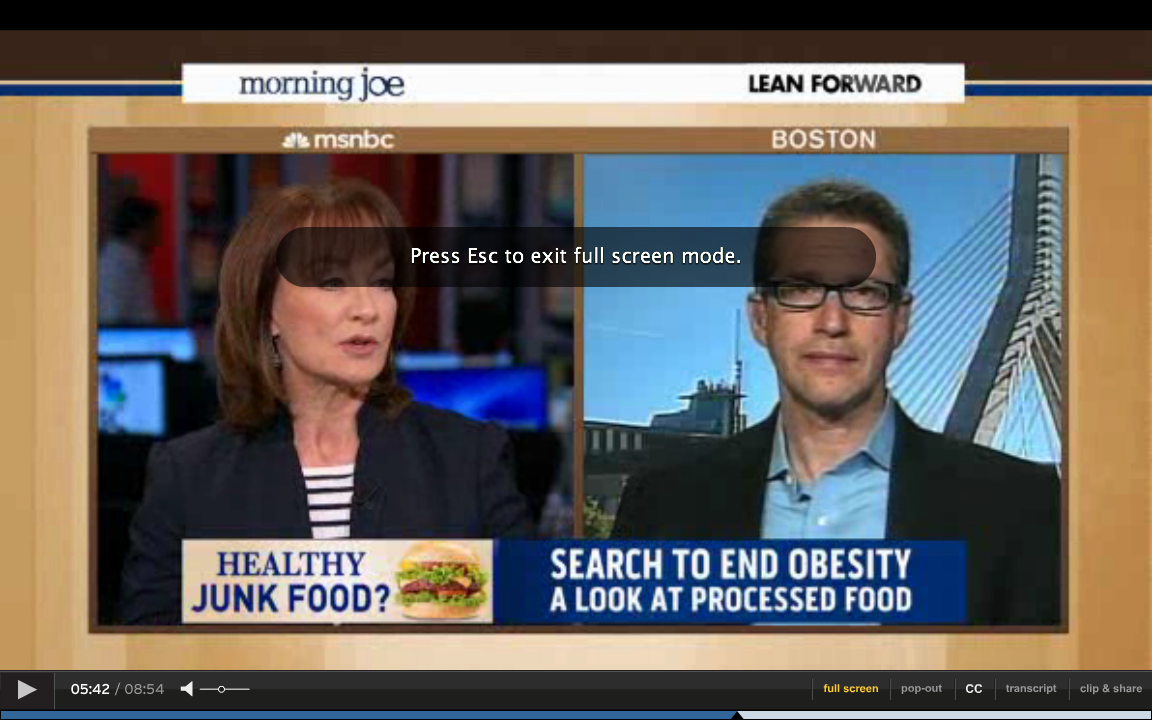
Searching an end to obesity: a look at processed foods

Click here to watch my June 21st appearance on MSNBC’s Morning Joe (segment begins 3:25).

To read my article in The Atlantic entitled “How Junk Food Can End Obesity,” click here.

Screen Shot 2013-06-24 at 6.45.11 PM

How Junk Food Can End Obesity

mag-issue-large

Demonizing processed food may be dooming many to obesity and disease. Could embracing the drive-thru make us all healthier?

From my cover story in the July/August issue of The Atlantic 

Late last year, in a small health-food eatery called Cafe Sprouts in Oberlin, Ohio, I had what may well have been the most wholesome beverage of my life. The friendly server patiently guided me to an apple-blueberry-kale-carrot smoothie-juice combination, which she spent the next several minutes preparing, mostly by shepherding farm-fresh produce into machinery. The result was tasty, but at 300 calories (by my rough calculation) in a 16-ounce cup, it was more than my diet could regularly absorb without consequences, nor was I about to make a habit of $9 shakes, healthy or not.

Inspired by the experience nonetheless, I tried again two months later at L.A.’s Real Food Daily, a popular vegan restaurant near Hollywood. I was initially wary of a low-calorie juice made almost entirely from green vegetables, but the server assured me it was a popular treat. I like to brag that I can eat anything, and I scarf down all sorts of raw vegetables like candy, but I could stomach only about a third…read more.

Tagged

Survival of the wrongest

januaryfebruary2013cover_300x400How personal-health journalism ignores the fundamental pitfalls baked into all scientific research and serves up a daily diet of unreliable information.

From my cover story in the January/February issue of the Columbia Journalism Review

In late 2011, in a nearly 6,000-word article in The New York Times Magazine, health writer Tara Parker-Pope laid out the scientific evidence that maintaining weight loss is a nearly impossible task—something that, in the words of one obesity scientist she quotes, only “rare individuals” can accomplish. Parker-Pope cites a number of studies that reveal the various biological mechanisms that align against people who’ve lost weight, ensuring that the weight comes back. These findings, she notes, produce a consistent and compelling picture by “adding to a growing body of evidence that challenges conventional thinking about obesity, weight loss, and willpower. For years, the advice to the overweight and obese has been that we simply need to eat less and exercise more. While there is truth to this guidance, it fails to take into account that the human body continues to fight against weight loss long after dieting has stopped. This translates into…read more.

Tagged

Warped Sense of Time Heightens Temptations

ImageImpulsivity arises from a tendency to want small imminent rewards more than big future benefits. How can we correct our skewed values to care for our future selves?

From my article in Scientific American

(Preview only, full article requires subscription or payment) 

Walk into any fast-food restaurant, and you can watch a small crowd of ordinary people doing something that is utterly irrational: eating junky, excess-weight-inviting food likely to leave them feeling bad about their bodies and open to a host of serious ills. We literally line up to trade our health and self-image for a few minutes of pleasant mouth feel and belly comfort—because the latter is right here, right now, whereas the former is months, years and decades away…read more.

Good News, Spock—We’re Getting Closer to a Universal Translator

The rapid advancement of Google-style, statistical translation may help realize this long-time dream.

From my Impatient Futurist column in the the March issue of Discover

Those of us for whom Star Trek serves as a benchmark for technological progress can only bemoan the fact that hopes for faster-than-light travel to other galaxies seem to be receding at warp speed, given that we no longer even have faster-than-sound travel to France. But I would prefer to focus on the bright side: We’re rapidly closing in on the Universal Translator, which means that when I do finally arrive in France, I’ll be able to communicate as easily as if I were on Earth.

The Universal Translator, of course, was a handheld device that 
instantly converted Captain Kirk’s futuristically clipped English into the language of whichever vaguely humanoid alien was offering to buy him a blue drink. It is impossible to overemphasize…read more

Evernote: Company of the Year

Evernote is rejecting industry trends, getting customers to pay for something that’s free, and reinventing the way we remember

From my article in the December 2011 issue of Inc. magazine

Phil Libin remembers the moment he left childhood behind. It was nearly four years ago, when the funding for his Internet start-up fell through. He was 35.

   It had all been so much fun until then. But at 3 a.m., out of cash and having waited in vain for a venture capitalist or angel or CEO or anyone at all to return his increasingly desperate calls, Libin knew that he would have to pull the plug on Evernote, a software application that helps people remember things. “I realized I was going to have to wake up tomorrow and lay off everyone in the company,” he says….read more

Science Finds a Better Way to Teach Science

After doing some much-needed research, cognitive scienctists are suggesting a new way to boost students’ lagging scores: Get rid of the hallowed (and stultifying) classroom lecture

From my Impatient Futurist column in the the December 2011 issue of Discover

Teaching well is hard. I can cite my direct observations of the hundreds of victims of my occasional efforts over the years as a teacher of physics and writing. As I have stood lecturing brilliantly to a few dozen purportedly eager collegians, it has not escaped my attention that at any one time only three or four seem awake enough to keep up with their text messaging.
   Clearly the problem is not the content or presentation style of my lecturing, which, as I may have neglected to mention, is brilliant, or so I was once assured by a student who stayed after class to ask for a sixth extension on an assignment. Then again, from what I recall of my college days, I wasn’t exactly on the edge of my seat at my professors’ lectures, either. And most of my fellow lecturers don’t report much different. Could the problem be with the nature of lecturing itself?…read more

The Man Who Gave Us Less for More

Examining the crushing success of Steve Jobs

From my article in the January 2012 issue of Discover
(#8 of the top 100 science stories of 2011)


I was front row center when Steve Jobs unveiled the Apple Macintosh to the world in 1984 in 
Boston. While the crowd cheered and clapped 
and squealed, I was scratching my head. What did this pretty beige box offer that a hundred other computers didn’t already offer, besides a higher price, much less choice in software, and no 
compatibility with the rest of the world’s devices?…read more

Layer by Layer

With 3-D printing, manufacturers can make existing products more efficiently—and create ones that weren’t possible before

From my article in the January 2012 issue of Technology Review

GE thinks it has a better way to make jet-engine fuel injectors: by printing them. To do it, a laser traces out the shape of the injector’s cross-section on a bed of cobalt-chrome powder, fusing the powder into solid form to build up the injector one ultrathin layer at a time. This promises to be less expensive than traditional manufacturing methods, and it should lead to a lighter part—which is to say a better one.

The innovation is at the forefront of a radical change in manufacturing technology that is especially appealing in advanced applications like aerospace and cars. The 3-D printing techniques won’t just make it more efficient to produce existing parts. They will also make it possible to produce things that weren’t even conceivable before—like parts with complex, scooped-out shapes that minimize weight without sacrificing strength. And the technology could reduce the need to store parts in inventory, because it’s just as easy to print another part—or an improved version of it—10 years after the first one was made. An automobile manufacturer receiving reports of a failure in a seat belt mechanism could have a reconfigured version on its way to dealers within days…read more

In Memoriam: The Space Shuttle

With great ambivalence we note the passing of 
the first and only reusable spaceship, the space shuttle, 
on July 21, 2011. Our prayers are with NASA.

From my article in the January 2012 issue of Discover
(#6 of the top 100 science stories of 2011)

The space shuttle, which long served NASA and humankind as a low-Earth-orbit 18-wheeler, died on July 21 at the NASA Kennedy Space Center in Florida, after gliding to an uneventful touchdown from a routine mission. It was 39 years old. The shuttle program had been suffering for several years from a wasting loss of enthusiasm for its high price tag and untamed risks. The final cause of death was failure to find any reason to keep pouring billions of dollars into an obsolete space ferry that lacked a stirring mission…read more

A Few TV Appearances

I was on John Stossel’s show on Fox in September, discussing why experts often turn out to be wrong. You can watch it by clicking on the “play” icon above, or by going here.

And because of Andy Rooney’s death, I thought I’d repost the CBS segment in which Rooney and I tour his office to discuss the useful role that clutter can play. You can see the clip here.

Why Economic Models Are Always Wrong

A fundamental problem with the mathematics of models ensures we’ll always get unreliable predictions

From my article on the Scientific American Website, posted Oct. 26, 2011 (A companion piece to my feature article on economic models in the Nov. 2011 print edition, posted just below
)

When it comes to assigning blame for the current economic doldrums, the quants who build the complicated financial risk models, and the traders who rely on them, deserve their share of the blame. But what if there were a way to come up with

simpler models that perfectly reflected reality? And what if we had perfect financial data to plug into them?

   Incredibly, even under those utterly unrealizable conditions, we’d still get bad predictions from models.
   The reason is that current methods used to “calibrate” models often render them inaccurate….read more

Study proves it’s not unhealthy to be overweight? Nah.

Researchers at the University of Manitoba have released a study on the relationship between body mass and health problems. Here’s a typical mass-media report on the findings, headlined, “Overweight people don’t have bigger health problems, study finds.”
 
It’s an epidemiological study, which means researchers looked back at a bunch of historical data about people and then tried to draw associations between those people with certain characteristics or behaviors, and how they fared over time. Epidemiological studies are much cheaper and easier and usually quicker to do than almost any other type of study, and they seem impressive because they often involve large numbers of people. But they also are some of the least reliable studies, being typically plagued with just about every problem that a study can have, including confounders (what happens to people in the study may have little or nothing to do with the causes that are being looked at), confusion of cause and effect (what happens to people in the study may actually be causing the factors that are being studied, rather than being caused by them),unrepresentative samples (the people being studied may not be typical of the population we care about), trying to draw conclusions from small differences, and more. Most studies about the relationship between health and weight we hear about are epidemiological studies,and we’ve had ample evidence over time that these are some of the least reliable among generally unreliable epidemiological studies.
But there may be something else to worry about with the conclusions of this Manitoba study, something that makes me wonder if the findings are actually right–but not for the reasons implied in reports of the study. 
Last year I met with Oberlin College biologist Keith Tarvin, who studies foraging behavior in animals. Tarvin explained to me that throughout most of the animal kingdom, animals will generally put on excess weight when provided with plenty of calorie-rich food and not givenany reason to be physically active, such as having to forage or hunt for food, or having to avoid predators. (Animals that need to keep weight down in order to survive are sometimes an exception–birds,for example, can’t fly if they get too heavy.) Situations where animals lose weight, on the other hand, are usually associated with some pathological state or threat–as for example when fish keep weight off in order stay small to be less visible to and appealing to predators, or to slow their maturation in order to preserve fertility and lower energy needs during times of drought, extreme temperatures,food shortages or other environmental pressures.
In other words–and at this point I’m merely expressing a conjecture that came up in my chat with Tarvin—it may be that, weight-related health factors aside, having a stronger appetite is associated with being well-suited to the environment. Or to put it differently,keeping weight off when there is plenty of rich food around and no pressing reason to be physically active is, in a sense, a pathological state. Apply this theory to human society today–and at this point I’m degenerating into my own conjecture–and we might well predict that being overweight is associated with being, in some ways at least, healthier than those who keep weight off.
Does this mean we should stop worrying about being overweight? Absolutely not. To conclude as much would be confusing cause and effect. If this conjecture is right, it means that being overweight is in someways an effect of being healthy; it doesn’t mean that being overweight confers any health benefits. And in fact, the possible rightness of this conjecture should have no bearing whatsoever on the well-established fact that carrying excess fat is generally unhealthy, and that people improve their health and lower their health risks when they lose excess fat.
Even if it’s true that people who are overweight are in many cases healthier in some ways than many people who are not overweight, theselucky overweight would still on average even further improve their health by losing the excess weight, and those who are not overweight would become less healthy by putting on excess weight.That doesn’t mean that weight loss is a pathological state, even though it’s usually associated with one in the animal kingdom. We should understand that the loss of excess weight is a good thing,even if, in a way, it is an unnatural thing in our society of plentiful, overly stimulating, calorie-dense food and sedentary lifestyles. That’s why our goal should be, in effect, to change what’s natural in our society–so that people are pushed by everything they see around them to avoiding excess weight, rather than being pushed to consume rich food and avoid physical activity as they are today.
To have even a decent chance of proving that losing excess weight will make you healthier–or to solidly prove just about any theory about the relationship between excess weight and health–we’d need a randomized controlled trial in which people are randomly assigned to either become fatter than they are, or lose weight, or maintain their weight. That trial is never going to happen, for what I hope are obvious reasons. And this brings us back to the problems with epidemiological studies like the one done in Manitoba. They rarely answer the questions we really want to ask. Instead, they give us answers that only raise more questions. There’s nothing wrong with that–it’s how science operates. We should be grateful scientists are conducting these studies, and appreciate the fact that they add to our knowledge base. But we should also be aware of the extreme limitations and qualifications that attach to the findings.
Inthe case of the Manitoba study, I think it’s fair to say the study at best tells us little about the healthfulness of avoiding being overweight, and at worst is, at least in how it’s being reported,extremely and even dangerously misleading. One of the biggest problems with the obesity crisis is the lack of awareness and motivation on the part of a sizable percentage of overweight people.When a study like this gets press claiming that being overweight seems to be as healthy as not being overweight, we take a big step backwards, and cause real damage that could in principle be measured in the loss of many years of life in the population, not to mention the drop in quality of life experienced on average by the overweight.I wish scientists and journalists would start taking these issues into account in their reports to journals and the mass media.

A Formula for Economic Calamity

Despite the lessons of the 2008 collapse, Wall Street is betting our future on flimsy science

From my article in the November 2011 issue of Scientific American

The market crash of 2008 that plunged the world into the economic recession from which it is still reeling had many causes. One of them was mathematics. Financial investment firms had developed such complex ways of investing their clients’ money that they came to rely on arcane formulas to judge the risks they were taking on. Yet as we learned so painfully three years ago, those formulas, or models, are only pale reflections of the real world, and sometimes they can be woefully misleading….read more

The Best American Science and Nature Writing 2011

[Includes my Atlantic article profiling meta-researcher John Ioannidis]


From the introduction, by Mary Roach:

…Good science writing is medicine. It is a cure for ignorance and fallacy. Good science writing peels away the blinders, generates wonder, brings the open palm to the forehead: Oh! Now I get it! And sometimes it does much more than that…. (See the book.)